“People should stop training radiologists now.”
— Geoffrey Hinton, 2016 conference recording
Nearly a decade later, radiology’s problem is finding enough people. A US workforce study found that the number of radiologists grew 17.3% between 2014 and 2023, while imaging volumes grew faster still. ACR workforce update, February 2026
That gap does not establish that AI has had no effect. It shows why identifying a task that a machine can perform is only the beginning of an employment forecast. The rest depends on how much work the task represents, how demand responds, and what new work appears around the technology.
These cases point to different mechanisms. Radiologists face unmet demand. Lawyers can save time on some tasks while their career ladder changes. Robotaxis automate the driving role and generate demand for separate jobs operating and maintaining the fleet. An employment forecast needs to account for both the work that disappears and the work that emerges.
Radiology: fewer reads, unmet demand
In the UK, demand for CT and MRI imaging grew 8% in 2024, while the radiologist workforce grew 4.7%. The Royal College of Radiologists’ next census estimated a 32% staffing shortfall in 2025. Hiring more people had not closed the gap. RCR 2024 census findings, RCR 2025 census findings
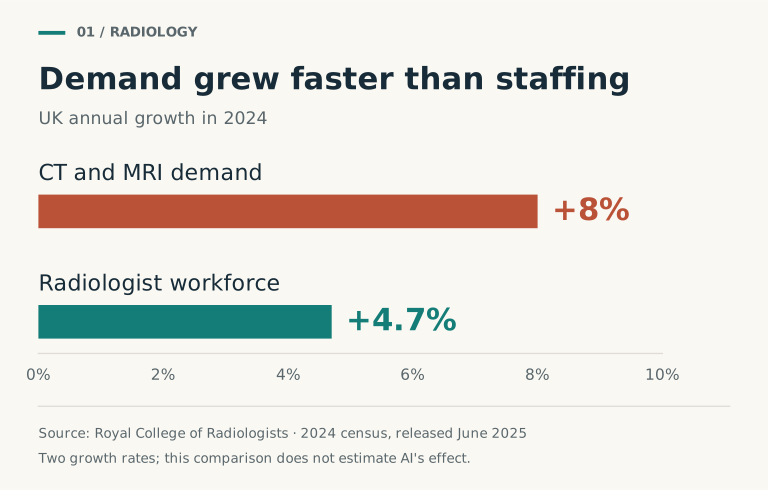 Figure 1. Annual growth in demand and staffing, as reported by the RCR. This comparison does not estimate AI’s effect on either measure.
A job title hides much of the work. “Radiologists read scans” compresses a sequence of decisions into the output outsiders see. Radiologists also compare earlier examinations, consider patient history, decide which findings matter, and communicate an interpretation that another physician can act on. A review of radiology workflows identifies opportunities for AI throughout that process, including protocol selection, record review, interpretation, and reporting. Jing et al., 2025
The gains within a task can still be substantial. The Swedish MASAI randomized trial assigned 105,934 women to AI-supported mammography screening or standard double reading. Its 2025 analysis reported 44.2% fewer human screening reads, alongside higher cancer detection: 6.4 versus 5.0 cancers per 1,000 participants. Hernström et al., 2025
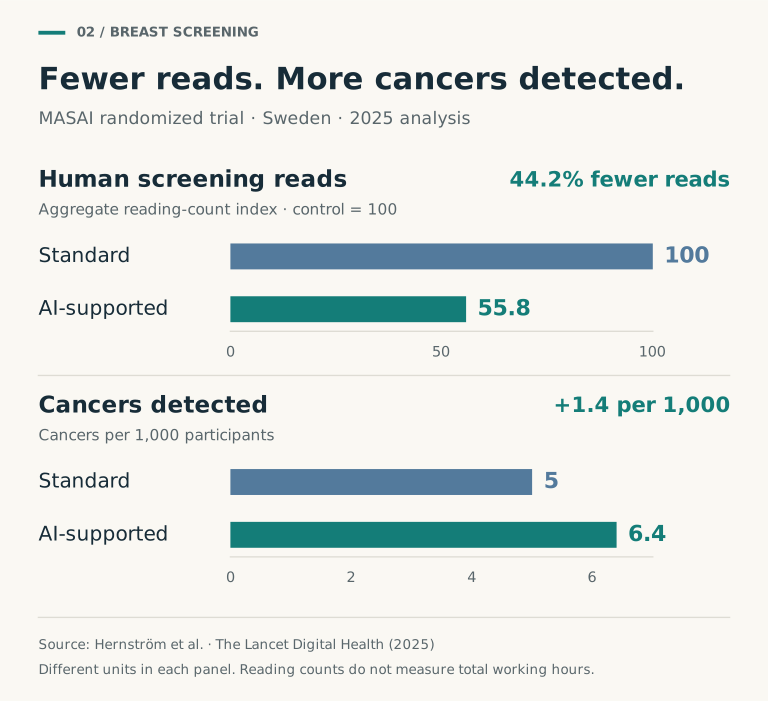 Figure 2. The panels use separate scales and different units. Reading counts are indexed to the control group. The analysis included 53,043 participants with AI support and 52,872 with standard screening, after 19 exclusions.
Here, the denominator is the story. AI directed examinations to one or two human readers and highlighted suspicious findings. The reduction concerned screening reads against a standard two-reader workflow. It did not measure an equivalent reduction in all radiologist work. Human interpretation remained part of the process.
To turn this result into an employment forecast, we need to know how much of the working day screening occupies, how much time each read takes, and where the freed capacity goes. In a service with waiting lists, some of it could become additional examinations or shorter delays. Those are questions about the organization, beyond the model’s accuracy.
Robotaxis: replacing drivers, creating different work
For a robotaxi trip within its operating area, AI performs the driver’s central job: taking a passenger from point A to point B. The service can complete that trip without an onboard driver. Cleaning the car afterward or repairing it at a depot does not change what has been automated.
Waymo reported over 250,000 paid trips a week in July 2025 and over 400,000 weekly rides across six US metropolitan areas in February 2026. Its sustainability page, accessed September 14, 2026, reports over 500,000 fully autonomous trips a week. July 2025 deployment update, February 2026 company update, Waymo sustainability page
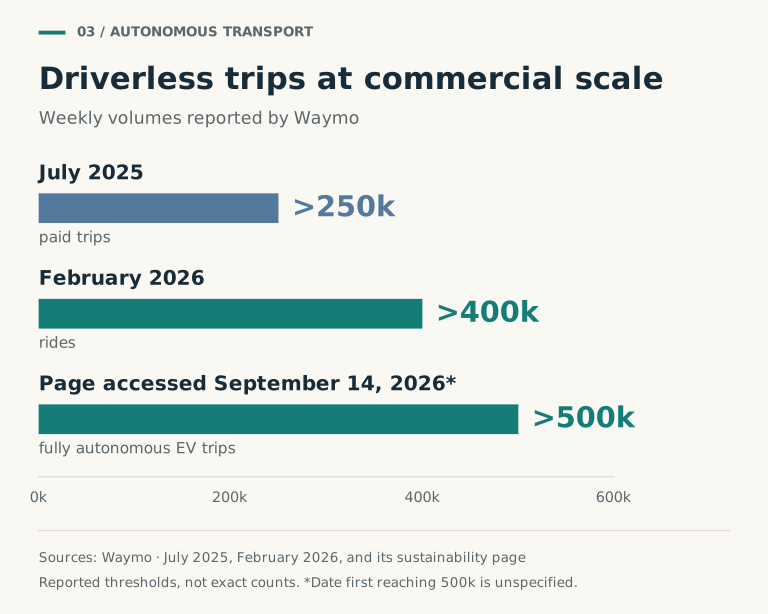 Figure 3. The automated driving service is scaling. These company-reported thresholds use different wording; the final date is an access date. Trip counts alone measure neither driving jobs displaced nor jobs created elsewhere.
The automated service also creates demand for a separate workforce, including at other companies. Waymo’s Dallas partnership assigns Avis responsibility for vehicle readiness, maintenance, infrastructure, and depots. The driving role can disappear while the fleet operator takes on other work. Dallas deployment update
The job descriptions make the shift concrete. Avis’s autonomous-vehicle technician posting describes electrical repairs, software diagnostics, firmware updates, and system calibration. Waymo also disclosed roughly 70 remote-assistance agents on duty at a time for a fleet of 3,000 vehicles in February 2026. It says these agents provide requested advice rather than remotely drive the cars. These are distinct roles supporting the automated service. Avis autonomous-vehicle technician role, Waymo remote-assistance disclosure
Replacing a job and creating other jobs can happen at the same time. Some supporting work, such as cleaning and routine maintenance, already existed around human-driven vehicles. Automation can change its scale, employer, or required skills, alongside demand for specialized roles. Hiring to support an autonomous fleet is evidence of that demand; it does not by itself establish how many additional jobs exist across the economy.
The next question is how the two sides compare. How many driving hours disappear, how many jobs are added elsewhere, what do they pay, and can former drivers qualify for them? A technician position requiring different skills is a real opportunity, but it is not an automatic transition for the displaced driver.
Answering that requires tracking both drivers and the businesses supporting autonomous fleets. BLS estimates that 86% of US taxi drivers were self-employed in 2025, so an employee-payroll series would miss most of the driving workforce. A robotaxi ride might also replace a private-car journey or be a new trip, rather than displace a human-driven fare. BLS taxi-driver profile
The lesson is that an occupation can shrink while a new service creates employment around it. The pace of deployment and demand for rides affect both sides; their balance has to be measured.
Law: faster tasks, a changing career ladder
A randomized experiment conducted in October 2024 compared law students using Vincent AI, o1-preview, and no AI. Of those enrolled, 137 completed at least one task. Published in 2026, the study found estimated time savings of roughly 20–33% on several tasks. Neither tool significantly reduced the time spent drafting a nondisclosure agreement, and quality effects varied. Schwarcz et al., 2026
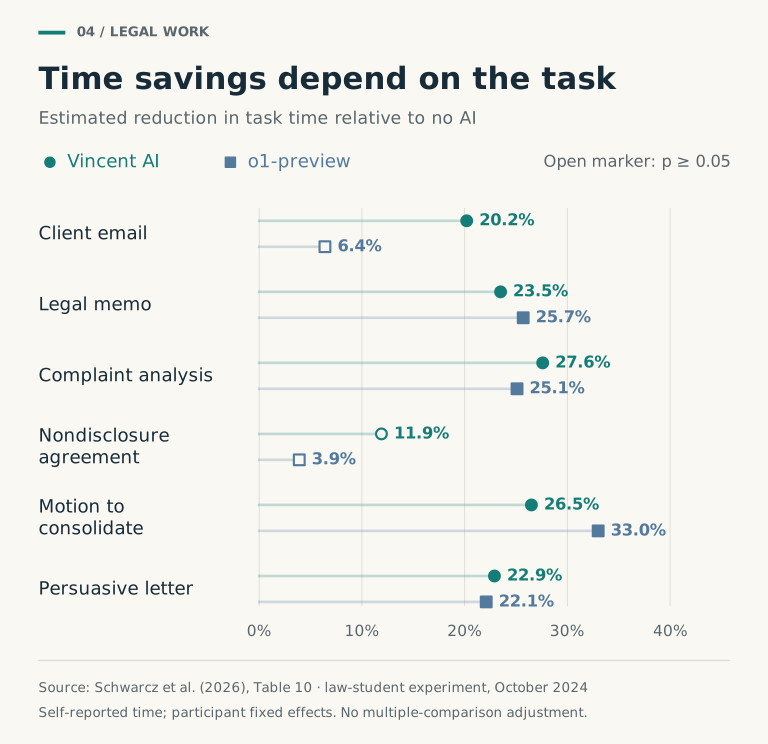 Figure 4. Table 10’s participant fixed-effects estimates, using self-reported time. Open markers indicate estimates that are not statistically significant at 5%. Tests are not adjusted for multiple comparisons. These are law-student task results, not whole-job estimates for practicing lawyers.
Legal work also includes advising clients, choosing a strategy, negotiating, and representing people in proceedings. Faster document preparation changes one component of that work. BLS lawyer profile
Meanwhile, demand has continued to grow. The 2026 Thomson Reuters/Georgetown report, drawing on 184 US firms, found that the average firm’s billable hours rose 1.9% in 2025 through November. That measures the volume of work independently of billing rates, although it does not isolate an AI effect. 2026 legal-market report
The entry market tells a more complicated story. NALP reported 92.8% employment among Class of 2025 graduates with known status, down from 93.4% for the previous class. Firms with more than 500 lawyers hired 6,588 graduates, down 7.5%. The graduating class was smaller, and federal hiring cuts and other market changes also affected outcomes. These figures cannot identify AI’s contribution. NALP Class of 2025 findings
Still, they illustrate a distinction worth watching: a profession can remain busy while offering fewer openings to beginners. One possible outcome is fewer junior hours per matter, more review by experienced lawyers, and additional client work. Whether new demand preserves entry-level hiring depends on how much it grows and who does the remaining work.
Software: measure the work that gets finished
Software development offers a particularly clear example of why impressions need checking. In an early-2025 randomized experiment, METR studied 16 experienced open-source developers completing 246 tasks in familiar repositories. Before using AI, they expected it to cut completion time by 24%. Afterward, they believed it had cut time by 20%. The measured result was 19% more time. METR, July 2025
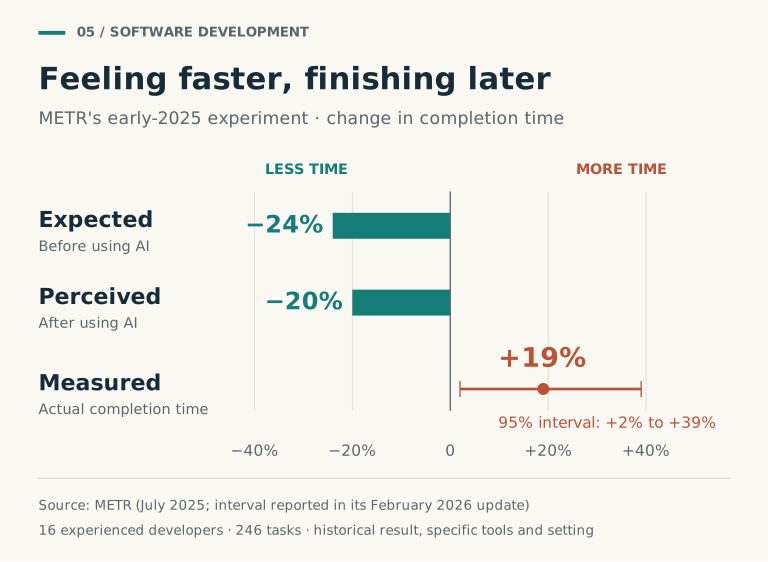 Figure 5. Negative values mean less completion time; positive values mean more. Expectations and retrospective beliefs are self-reports. The measured estimate’s 95% interval is +2% to +39%, as reported in METR’s February 2026 update. This is a historical result for a specific setting.
The experiment includes work that a code-generation demo can leave out: meeting an established project’s standards for testing, documentation, and code quality. Producing plausible code is one step toward finishing a change that belongs in the repository.
The evidence also changed. In February 2026, METR reported follow-up estimates pointing toward faster work, but said recruitment and task-selection biases made the size unreliable. Some developers declined to work without AI; concurrent agent use also complicated time measurement. The researchers believed the tools were likely helping more than before. METR follow-up and limitations
Treating the old slowdown as a permanent verdict would make the same forecasting mistake in reverse. Measure completed work, specify the users and tools, and update the result when the setting changes.
Demand changes the arithmetic
Even a reliable productivity estimate leaves an employment question unanswered: how much work will people want done?
A study in The Quarterly Journal of Economics followed the introduction of an AI assistant among 5,172 customer-support agents. Access increased issues resolved per hour by about 15% on average, with gains around 30% for less skilled and less experienced workers. Brynjolfsson, Li, and Raymond, 2025
Take the average gain and apply it to two simple scenarios. Assume the productivity improvement applies to the full workflow, output quality stays the same, and hours per worker do not change.
| Demand | Human hours required |
|---|---|
| Unchanged | About 13% fewer 1 ÷ 1.15 ≈ 0.87 |
| 30% more | About 13% more 1.30 ÷ 1.15 ≈ 1.13 |
These are arithmetic scenarios, not job-loss or job-creation findings from the study. The same improvement supports opposite staffing outcomes depending on demand. In practice, scheduling, staffing minimums, and the mix of tasks also affect how hours translate into headcount.
Demand can grow for reasons independent of AI, as an aging population needs more imaging. It can also respond to lower costs: software projects, legal services, or customer support that were once too expensive become worth commissioning. Time saved may fund a larger ambition.
This is where Jevons paradox needs a precise definition. In The Coal Question (1865), William Stanley Jevons argued that more efficient coal use could expand industry enough to increase total coal consumption. Efficiency can encourage so much additional use that the resource savings are outweighed. Jevons, chapter VII
For AI, the resource matters. Cheaper inference could increase computing demand while reducing demand for particular workers. An analogous increase in employment requires the expansion of work to outweigh the reduction in human hours per task. More driverless rides, for example, can expand work in fleet operations while demand for drivers falls. A forecast of total employment must include both occupations.
A labor shortage makes this accounting especially relevant. An occupation can keep growing while AI reduces the staffing required for a given volume of work. Its growth alone cannot tell us how many people it would have employed without AI.
Deployment has its own timetable
Capability, workflow improvement, and organizational adoption happen on different schedules. A tool must connect to existing systems, fit the way people work, and have a process for failures and responsibility. Radiology workflow research, for example, identifies integration with imaging and health-record systems as necessary for realizing efficiency gains. Jing et al., 2025
These costs can fall as tools improve and organizations learn. They still belong in a forecast from the start. A model returning an answer in seconds tells us little about how quickly a hospital, law firm, or transport service can reorganize around it.
Watch hiring as well as layoffs
Employment can change without a wave of dismissals. Employers can leave vacancies unfilled, reduce graduate recruitment, or grow with smaller teams than they otherwise would have needed.
An August 2026 Stanford analysis of ADP payroll data through June found employment among workers aged 22–25 in highly AI-exposed occupations about 19% below the level implied by keeping pace with similarly aged workers in less-exposed occupations. Experienced workers showed no comparable gap. The adjustment appeared to operate mainly through reduced hiring. Brynjolfsson, Chandar, and Chen, August 2026
The authors describe these as descriptive patterns, not causal estimates of AI’s effect. The comparison does not mean AI eliminated 19% of young workers’ jobs. Other forces could explain some of the divergence. It does show why a forecast should examine entry routes and hiring alongside the total number of people already employed.
What a useful forecast must explain
Before turning a capability improvement into a prediction about a profession, ask:
- Which tasks change? Estimate their share of human working hours, including review, corrections, and unusual cases.
- What improves in the full workflow? Measure completed work at an acceptable level of quality, alongside the costs of supervision and integration.
- How quickly can employers adopt it? Include infrastructure, organizational changes, and the cost of handling failures.
- How does demand respond? Distinguish growth that would happen anyway from work made worthwhile by lower prices or better service.
- What work is created? Account for new roles and additional demand for existing services, including jobs at suppliers and contractors. Distinguish that hiring from the net change in employment.
- Who can move into the new work? Track hours, earnings, hiring, and exits, alongside differences in skills, location, and training requirements. Jobs created and jobs lost may belong to different people.
Radiology shows unmet demand alongside substantial savings in screening work. Law shows faster tasks and continued demand alongside a changing entry market. Robotaxis show the driving role being automated while separate work emerges around the fleet. Software shows how much a productivity result can depend on the users, tools, and work being measured.
A profession’s survival and the economy’s demand for workers are different questions. AI can eliminate a role while creating opportunities elsewhere. Understanding that change requires an account of the work removed, the work created, and the people able to make the transition.
Count the work that disappears, the work that emerges, and who can move between them.
Sources and methods: Evidence is dated through September 14, 2026. Studies, workforce surveys, company disclosures, and illustrative calculations measure different things; their percentages should not be pooled. Source links accompany the relevant claims.