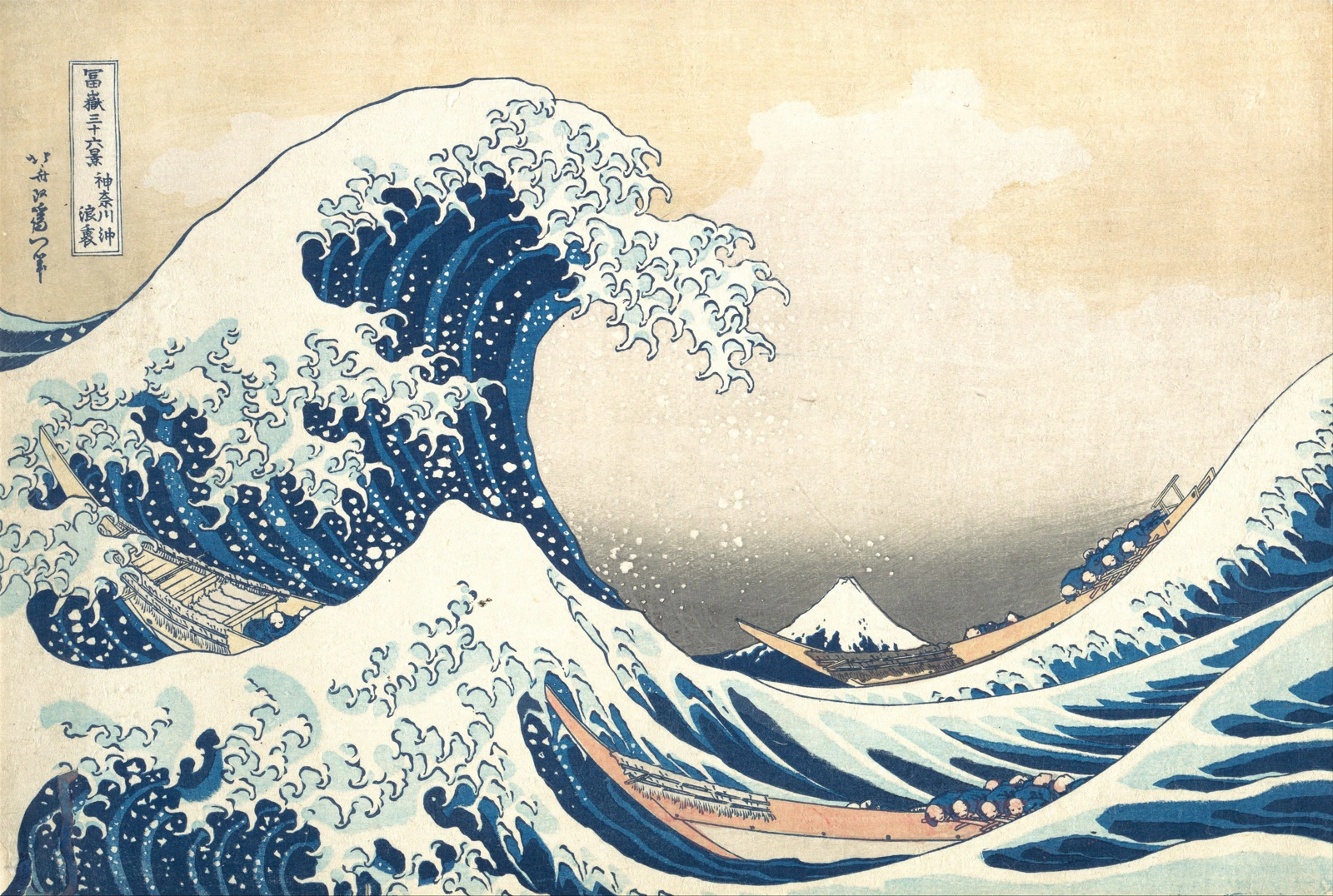

Hokusai’s wave already feels alive. I wanted to let its ink curl and its boats ride the swell, while keeping the print’s familiar shape.
I separated the boats, Mount Fuji, and waves into eight paper cutouts. AI filled hidden areas and extended the sky and sea so the whole crest stays visible on different screens. These additions imagine what lies beyond the print.
Each piece rocks at its own pace. Within the waves, the blue lines and white foam follow the curves of the ink. A deep lacquer-and-brass case holds the scene. Each layer meets its inner walls at a different depth, casting shadows below.
A slow, AI-generated koto score leaves room for recorded ocean waves. Sound starts automatically when your browser allows it, or after your first tap. Use Layers & flow to adjust the ocean or switch to a real flute recording.
Artwork & sound credits
After Katsushika Hokusai, Under the Wave off Kanagawa, ca. 1830–32. Public-domain image: The Metropolitan Museum of Art, H. O. Havemeyer Collection, 1929.
Quiet Tide was generated locally with ACE-Step 1.5. Its slow solo-koto direction takes inspiration from Lucas Ferreira’s Snowfall. It is a new AI interpretation, not a historical Edo-period recording; the reference audio is not sampled.
The recording option uses muhamor’s shakuhachi improvisation. Ocean Waves by Noted451 supplies the surf. Both are edited into loops and released under CC0.
Further listening: a koto performance of Sakura Sakura, recorded by Torsodog, available under CC BY 3.0. This recording is not sampled in the soundtrack.